
Marta Papini: Curating Without Easy Answers.
The Ribbon Drawn Across Bridges: An interview with curator Marta Papini
By Annalise June Kamegawa
Marta Papini, co-curator of Lonely Are All Bridges alongside Maurizio Cattelan, describes the works of Birgit Jürgenssen and Cinzia Ruggeri as existing “halfway between alive and not alive,” evoking a sense of movement that never fully materializes. Though they lived in the same era, the two artists never met in person, destined instead to remain parallel forces. The Fondazione ICA Milano exhibition brings their work together—two women who, with both playfulness and poignancy, grapple with the absurdity and beauty of womanhood, always revealing the truth that lingers just beneath the surface.
Annalise June Kamegawa: You initially curated Lonely Are All Bridges for Galerie Hubert Winter in Vienna. How did the shift to ICA Milano shape or transform your vision for the exhibition? Were there particular aspects of the ICA space or Milan’s cultural context that invited new approaches or interpretations?
Marta Papini: The Hubert Winter gallery is a very beautiful space but the show in Vienna was done during COVID times so we didn't get to see the space before the opening. We mainly worked online with SketchUp, which is fairly easy to do with white cube spaces, but still is not the same as being in the space physically.
Here at ICA, the space was very different, it’s more articulated, and this is interesting because it creates the opportunity for more dialogs between the rooms. We managed to create a kind of ping pong of displays among the rooms. I was happy to do this second chapter in-person. I did a lot of site visits a ICA and it's not a conventional space. It has different heights. It has different lighting throughout the day. It has these fascinating surfaces with all those stains and marbles. That helped with configuring the show in a new way.
AJK: You’ve worked with Maurizio Cattelan before, not just on the first iteration of Lonely Are All Bridges, but also on The Artist is Present in Shanghai. How did your relationship begin and how have you come to curate these projects together over the years?
MP: Maurizio and I started working together at TOILETPAPER magazine, I was the project manager there at the very beginning of that editorial experience. I studied art history and then curatorship, and in that period we started collaborating on interviews with artists. We would select artists we thought were interesting for their research and interview them for magazines. If we find ourselves together in a city like New York or Milan, we usually go around and see exhibitions together. From this dialogue, the next natural step was to curate something together.
The first show we co-curated was Shit and Die in Turin in 2014, together with Myriam Ben Salah. Then we collaborated on The Artist is Present, and then this show (with probably some other things in the middle). Shit and Die was my first experience in curating, he was more of a professional curator compared to me! It was fun and thoughtful at the same time. Thanks to Maurizio I realized from the very beginning of my curatorial carrier that there is no one way to think of an exhibition.
AJK: When I entered the exhibition, I didn’t even notice Cinzia Ruggeri’s sculpture Chef + Rèmy (2018), which balances humor with a sense of melancholy. The pieces in the exhibition feel so humorous that the loneliness almost goes unnoticed.
MP: I think it's always like that with art– you see and understand based on how you feel in that moment. I feel a lot of melancholy, even if I acknowledge it is subtle. Take Jürgenssen’s piece, Bed Shoes (1974), with two beds one beside the other. They are shoes, but they are two single beds, empty and apart. Colombra (1990), with this long shadow making a dove with its hands, is like a Peter Pan that’s playing. I find sadness in this play, or better said, a bitter irony. There’s a bit of drama in every joke you see.
AJK: The poem from which the exhibition gets its name, The Bridges (1953) by the Austrian poet Ingeborg Bachmann, discusses the poetic tension of two parallel bridges. How do the themes in the poem come up in the exhibition?
MP: This sentence, “lonely are all bridges,” is such a powerful image. It immediately tells the fragility and transience of a bridge connecting two riverbanks. Both these artists struggled a lot and they refused to stay on one side only of the river, they wanted to cross disciplines, to navigate among art, fashion, design. Of course it was also an homage to a great Austrian poet.
AJK: The works of Cinzia Ruggeri and Birgit Jürgenssen are in such close conversation that their authorship almost blurs. How did you approach crafting this interplay?
MP: It was not a challenge, because some artworks or references really resemble each other, but if you go deeper, you discover they were quite different. They got to some very similar visual results, but at the same time, they were very different as people.
Birgit Jürgenssen was much more private and shy, staying outside the spotlight. She always created her art for herself. She did some shows, but she never had any international exhibitions during her lifetime. She was very much in her own space, in her studio, working on her own projects, without being influenced by the outside world. This is visible in her work because she continued to experiment with different ways of creating—not as a response to an audience's reactions, but because of her own internal drive.
Cinzia Ruggeri, instead, was more eclectic. She worked across many different disciplines, producing a variety of works, including unique pieces like Stivali Italia, but also creating design products, such as the sofa. Ruggeri approached art in a playful, pop, and lifestyle-oriented way, where art becomes a means to change aspects of daily life. Both artists had a lot in common, but they approached life and creative work in very different ways.
These two very different research paths found incredible overlaps in images, references, and themes—like the use of woman accessories, or the shadow play, for example. But as I mentioned before, I think this is part of a sincere need for women to express themselves, starting from their own bodies: transformation and metamorphosis are all part of their experience as women.
AJK: In the main exhibition room, there’s an enlarged photograph by Birgit Jürgenssen in which a shoe heel emerges from a hand followed by a long row of shoes designed by Cinzia Ruggeri. These two works present a daring juxtaposition of scale and context. How did you decide on this composition?
MP: So that was, like many good things that happen in shows, a plan B. That wall was supposed to be wallpapered with the photo, but we couldn't apply glue because it's a historical wall. So, we then switched to the canvas material that we were using for large photos in the first edition of the exhibition. For Ruggeri, I went to her archive and saw all these beautiful pairs of shoes in drawers and on shelves, and I immediately imagined them as a line along the long wall.
AJK: Any thoughts on navigating artists’ archives?
MP: I have a piece of advice for artists. I suggest organizing their estate when they are alive: you don't know when you will be dead. When you’re dead, you won’t know who will be taking care of it, and your work will get lost. Every artist should have that part of their ego that says, “Okay, this is my material. This is what I dedicated all my life to. This is how I want to archive it. This is who I want to operate it.”
Don't leave it to your friend. Don't leave it to your son or daughter. Don't leave it to parents or to any kind of relative. Go to a professional and say, “This is my archive. I leave it to you!” you need to take care of its future. You don't do art for your lifetime. You do art for after your lifetime. If you know any artists, go and tell them to organize their estate. ☺
AJK: Both Ruggeri and Jürgenssen explored objects in ways that subverted traditional associations of femininity. There’s often a gendered divide between what men and women make and how its framed. How does the exhibition address this divide, and in what ways do their works push back against such categorizations?
MP: I consider myself a transfeminist. That being said, I would not say this show revolves around just feminist issues. It is about women, their roles in society, and how these two artists problematized that very role. When I said they were avant-garde, I said that because it wasn’t easy being a woman in their times. I believe they both had to make a huge effort to get where they got. They were fighting with labels, especially Jürgenssen. She has been often labeled as a feminist artist, but I think it was simplistic. She was addressing some important issues about gender and the condition of women. Nevertheless, what was unfortunate was that there were a lot of feminists activist artists that she got compared against. I think this damaged the complexity and the reading of her work.
AJK: I think it's difficult, especially now, to work outside labels. So much current artwork is asked to have a social or political motivation. In line with that, those in the contemporary art sphere try and superimpose labels from today onto works in the past.
MP: While visiting exhibitions, I see a lot of rereading of what has been done in the past. It’s a pity that, through this synthesis we lose some complexity in the art. For example, I did not use the word “patriarchy” in Lonely Are All Bridges. I usually do when it's appropriate because I think it's important to say that we are living in a very patriarchal society. That being said, I didn't want to use it here because I'm sure that both the artists would not use it themselves. I hope this decision respects their views.
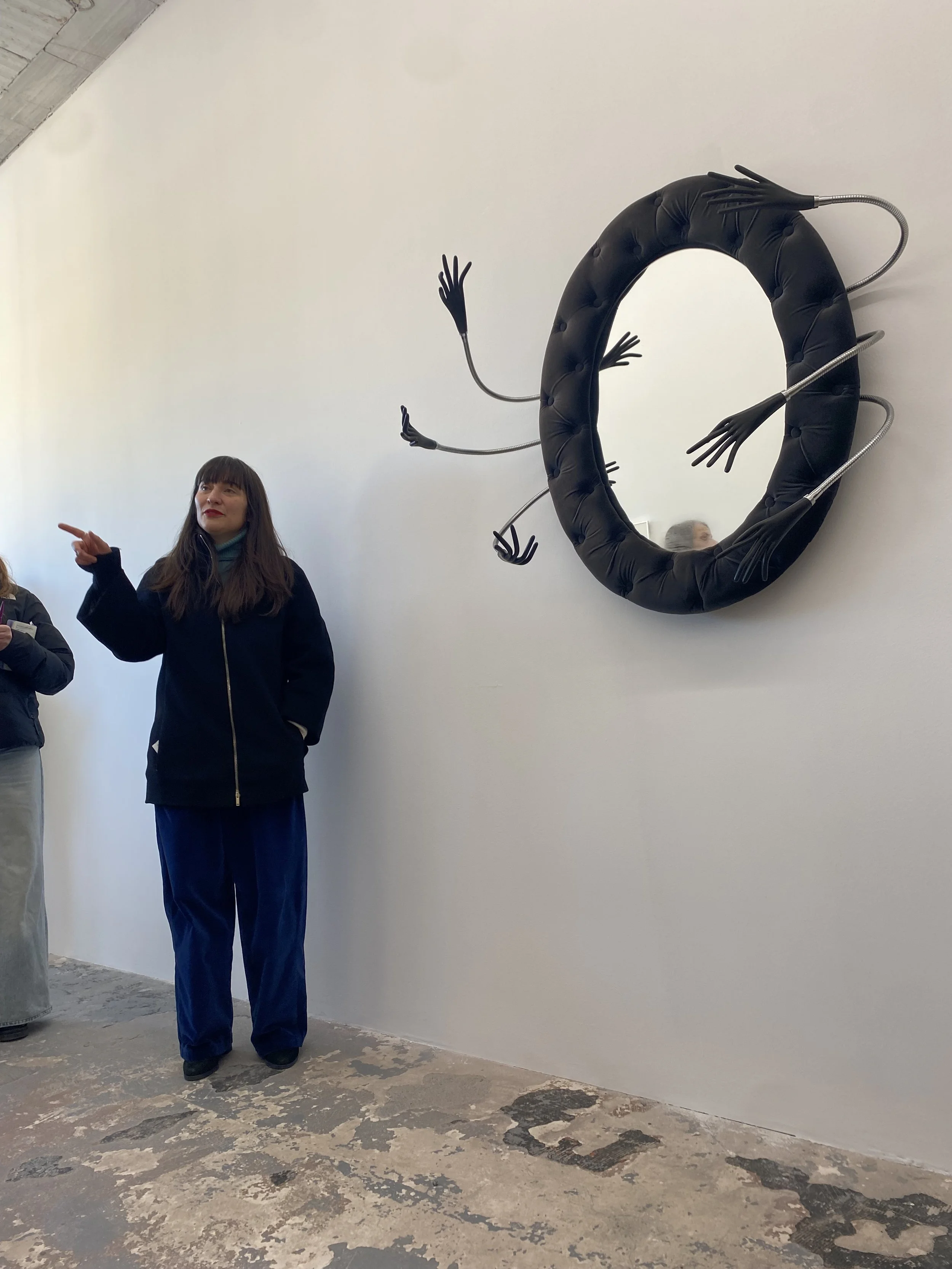
AJK: The secluded pathway in ICA with the latex photos and the velvet mirror feels almost hidden, inviting a sense of intimacy or even taboo. How did you approach designing this space within the exhibition?
MP: yes, it’s supposed to be a homey, comfy, and as you mentioned, intimate space. Natascha Burger, the director of the Birgit Jürgenssen estate, proposed these latex photos that have rarely been shown.
As you can see in those photos, her body parts become objects because of the deformation of the mirror. I thought it was a completely different mode of expression, so I wanted it to be very detached from the rest of the spaces. When I saw those photos, I thought of Cinzia Ruggeri’s Schatzi. It’s not very BDSM, but more fetish with its velvet frame. It became a nice dialogue between the two artworks.
In another space, I don't think it would have worked—it was just for that corridor. It was a good closure to the exhibition. You see yourself before turning back.
Marta Papini (Reggio Emilia, 1985) is an independent curator.
She is the curator of Radis, a four-year public art project promoted by the Fondazione per l'Arte Moderna e Contemporanea CRT, and associate curator of Il parlamento delle marmotte, 9th edition of the Biennale Gherdëina (2024), and of Thinking like a Mountain (2024-2026), with Lorenzo Giusti. In 2023 she was on the Future Generation Art Prize selection committee. She was the artistic organizer of Il latte dei sogni, 59th edition of the Venice Biennale, curated by Cecilia Alemani (2022). She has curated, co-curated, and organized several exhibitions, including Lonely Are All Bridges. Birgit Jürgenssen and Cinzia Ruggeri at Galerie Hubert Winter, Vienna (2021); Il mondo magico, Italian Pavilion at the 57th Venice Biennale (2017, curated by Cecilia Alemani); The Artist is Present, Yuz Museum, Shanghai (2018, with Maurizio Cattelan). She writes about contemporary art on Icon magazine.