Chloe Wise
Interview by Germano D’Acquisto @germanodacquisto
Photography by Logan Jackson @_loganjackson
Styling by Dax Reedy @____dax______
There’s a moment, standing in front of a painting by Chloe Wise, when you find yourself laughing — and then, almost immediately, realizing that laughter isn’t enough. Beneath the glossy surface of lights and condensed milk, there’s a raw nerve that speaks about us, about our time. Be careful: here’s someone who handles the icons of the present with disarming ease — with the surgical precision of an old master and the shamelessness of someone who knows that good taste is overrated.
A Montreal-born Canadian now based in New York, in a loft just steps from the Empire State Building, Chloe Wise has become a darling of galleries and fashion houses ever since she stirred up the fashion world with her Bagel Bag No. 5 — a Chanel-logo bag shaped like a bagel, worn at a party for Karl Lagerfeld. Since then, she has lined up shows with Gagosian and Almine Rech, campaigns for Jacquemus and Études, and a following that bridges art collectors and pop-culture enthusiasts. But behind the glamorous myth is an artist who wields irony like a scalpel, turning consumption itself into her aesthetic battleground.
Her canvases — peopled with friends, lovers, and exes, often nude, surrounded by camembert, caviar tins, Bic lighters, and tangled chargers — suggest that contemporaneity isn’t an era but an organized mess. Sculptures like Caesar Salad Chandelier or paintings like Lactose Tolerance play with the imagery of Rococo and the old masters, yet with the irreverent twist of a satirical comedy. And beneath the absurdity, there’s always a note of fragility: bodies as “flesh bags,” smiles that conceal wounds, bandages sealing what we’d rather not show.
At the end of October, her latest solo exhibition closed at Almine Rech’s Tribeca space in New York, is opening a new chapter in her practice. For this show, the painter revisited the history of the “visions of the sublime”: what we once called “seraphs” or “angels” now appear to us as extraterrestrial phenomena. Not because the experience has changed, but because the language through which we attempt to describe it has. The paintings on view referenced Caravaggio and El Greco — figures raptured by the unknown heavens — while also drawing from Spielbergian cinema, from those atmospheres suspended between the familiar and the uncanny.
In the works shown at 361 Broadway, the home became a kind of portal. A 1990s-style kitchen, for instance, played a looping sound piece created with Loke Rahbek: distorted voices, static noise, radio signals whispering of communion and close encounters. It was an installation exploring the notion of high strangeness — that unsettling feeling that, beneath the domestic and familiar surface, a crack opens toward the Other, toward the incomprehensible. As Diane Walsh-Pasulka writes in American Cosmic, and as Carl Jung theorized, celestial beings, angels, ghosts, UFOs may all be different manifestations of a single phenomenon — one that each era narrates in its own language.
With her Tribeca exhibition, Chloe Wise entered this canon of stories and myths, painting the ineffable without trying to explain it — letting it emerge instead in a domestic, uncanny atmosphere. Another way of reminding us that reality, like painting, is an organized disorder, and that behind laughter there’s sometimes a flash of vertigo. Her journey will continue next June at the Kulturstiftung Basel H. Geiger in Switzerland, where she’ll present a new solo exhibition.
We reached out to Chloe to talk about wounds, bad taste, and that strange, irresistible lightness with which she turns life’s chaos into paint.
In your Tribeca project, you seem to evoke a long tradition of representations of the sublime — from the sacred to science fiction. What fascinates you about this human attempt to give form to what is invisible?
I’m fascinated by how our desire to visualize the invisible — the sublime, the divine, the alien — is also a confrontation with the limits of perception itself. The material world, as we experience it, is already a translation: a chaos of vibrating particles that our senses and language filter to make legible, recognizable, something we call “reality.” But these tools — sight, language, cognition — hide as much as they reveal. That’s where storytelling comes in: we have always used myth, symbolism, and narrative to express the ineffable. From Ezekiel’s chariots of fire to modern UFO sightings, we translate the incomprehensible into familiar forms to make it bearable. In my new work, I thought about how religious painting and science fiction cinema both shape our capacity to imagine what can’t be quantified or understood. Biblical encounters with angels, for example, were terrifying and incomprehensible — more horror film than cherubic visit. Painting tamed them, turning them into the winged putti that populate our visual culture. Science fiction, from the 1950’s to today, did something similar: it expanded collective imagination, offering us the possibility of the “impossible” — and giving us a safer frame than the sheer horror of the unknown. My new paintings want to enter that tradition.
Your references range from Caravaggio to Spielberg, from Jung to Timothy Morton. How do these different languages help you build an aesthetic of contemporary mystery? And how important is it for you to preserve ambiguity in your works?
These new pieces are mysterious in a very unmysterious way: I paint deliberately ambiguous, suspended scenes, where figures always look beyond the canvas — upward or outward — toward something unknown. That void is intentional. I want the viewer — and even myself — to have space to imagine what lies beyond. I love that humans are almost biologically wired for wonder, faith, astonishment. One thing about the universe? It’s full of infinite mysteries!
Your work always seems on the verge of derailing — suspended between humor and melancholy, social critique and aesthetic play. Where do you position yourself within this tension?
The tension point between two opposites is always fascinating — it’s where instability or confusion begins that things get interesting. I never think about balance itself. I’m not balanced; I’m trying to stay balanced — and that’s a big difference.
You often describe the body as a “flesh bag” — both grotesque and marvelous. What does the body tell us today?
The body is full of absurdities, and yet it’s the only thing we can’t escape: our undeniable container. It does everything — ages, leaks, folds, peels, renews, secretes — and we relate to the world through its porous boundaries. I probably called it a “flesh bag” to underline the physicality and fragility of being finite, of being made of living matter, in connection with a series I called Torn Clean, about bodily anxieties and mortality. In a sense, all art inevitably confronts mortality, whether it wants to or not — it’s the one absolute guarantee (not to sound morbid). But the body is also playful: we decorate it, tattoo it, inflate it, sculpt it — it’s both beautiful and grotesque. It’s the site of all contradictions — love, shame, pleasure, control. It’s a tool and a product, a fact and a battleground. It’s private, yet our only way of appearing in public. All of this is profoundly unstable. Having a body is weird! Having a mind? Even weirder.
Fashion is part of your visual language. Do you consider it art — or just another stage for identity to perform itself?
I don’t consider fashion art, though it’s certainly artistic. I’m ready to be proven wrong — there’s so much overlap, and the two often merge. Fashion and art both respond to the desire to adorn, to decorate, to construct a sense of self — but they shouldn’t be flattened into the same category. I think art can easily, even accidentally, appear as fashion — but that’s another story. In the end, who cares about labels anyway?
The forced smile, the giant bandage, the fake nail — you seem drawn to everything that covers. Why?
I’m intrigued by the human obsession with recreating body parts to make them stronger, more perfect — to hide imperfections with prosthetics that are eerie copies of what’s natural and non-negotiable. False lashes, acrylic nails — they’re meant to enhance, to feminize, but the line is thin: when you find a detached lash or a fake nail on the ground, they become almost animal, abject. Lashes turn into scraps of fur, the nail into a lost piece of armor. At best, they merge with the body; at worst, they become grotesque caricatures. Bandages, too, are designed to imitate skin, to protect us from seeing our own healing process — the bandage is the scab of the scab. When one floats in a swimming pool, it reminds us of our mortality, of the fragility of skin, of the strangeness of seeing parts of ourselves detached. In a series of works, I compared the bandage to a smile. A smile, like a bandage over a deep wound, is a protective gesture — meant to hide what’s happening underneath, what we don’t want to show. A forced smile — unlike a spontaneous one or a laugh — flattens conflict, conceals complexity, offers a palatable image that keeps the social machinery running and maintains peace. I’m interested in these unspoken norms, the tacit rules we accept — the thin veil of order that prevents society from falling into chaos.
You often paint yourself and your friends. Is it a form of self-analysis — or a way to blur the private and public?
No, they’re just the people around me. I wouldn’t know who else to paint!
Humor is a constant in your work, but it’s never just a punchline. Is it hard to keep comedy and critique together?
Not at all. Comedy isn’t funny unless it contains critique. Jokes only work when they’re at least partially true, right?
If you had to represent today’s society with a single object, what would you sculpt?
If I knew, I would’ve already made it.
How do you imagine the future of visual art — more digital, more physical… or just more absurd?
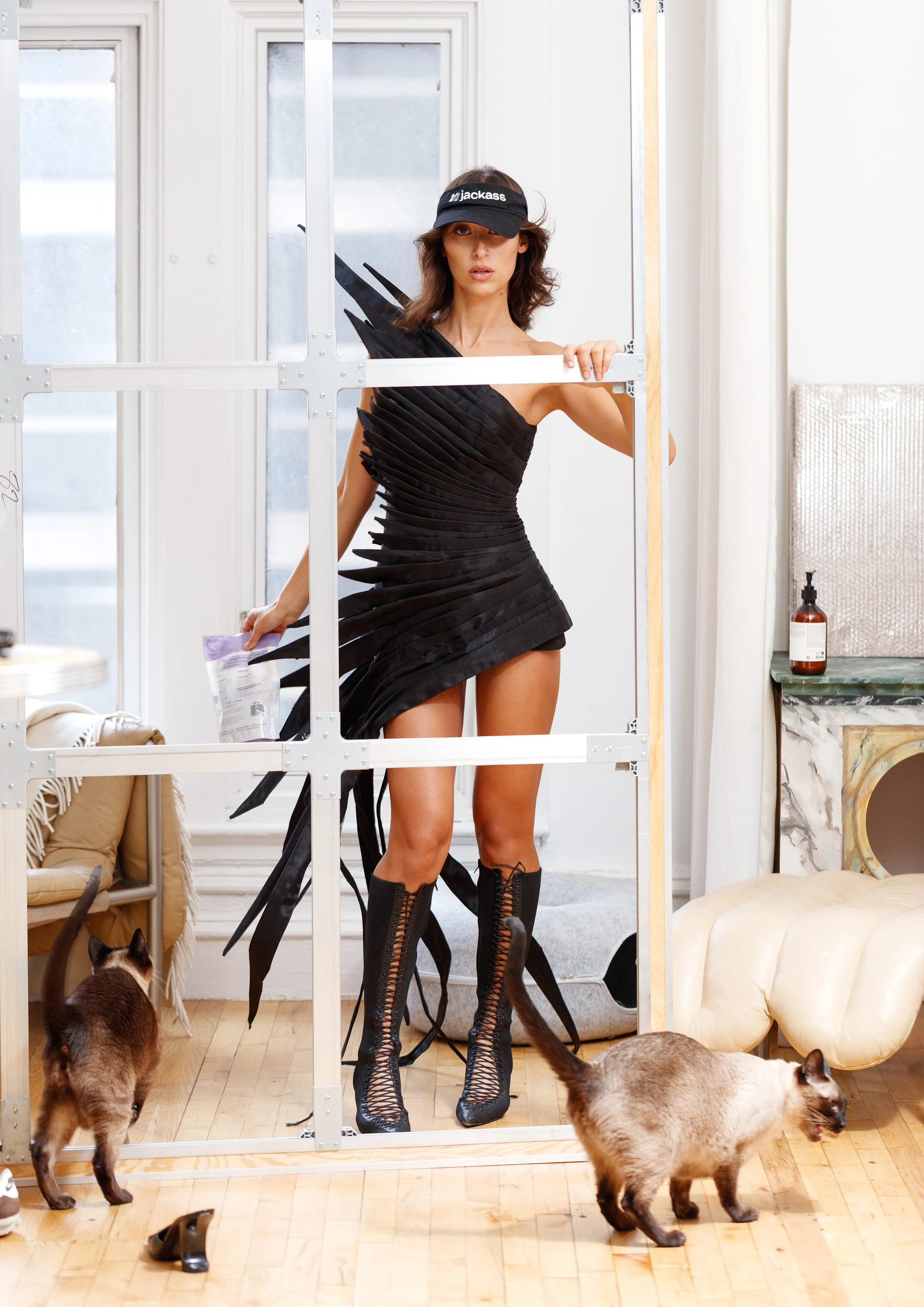
With AI, I think we’ll see a huge return to everything that bears the imperfect mark of the human hand — what only an individual can leave behind. I believe imperfection and error will become massive in the future. That’s why I leave my cat’s hair in my paintings. Also, it’s literally impossible to remove it all.
Your works often evoke a sense of domestic estrangement, as if behind every familiar gesture or object lurked something unsettling. Do you ever draw from that “Lynchian” aesthetic — the suspended silences, the too-perfect pies, the grainy dreams?
Yes.
Many contemporary narratives speak less of nostalgia and more of séance. How important is it for you to evoke memories that don’t belong to you — or seem borrowed from a distorted collective imagination?
That’s a beautiful way to put it. Collective memories, as part of a shared and unified dream, are exactly what I try to represent in my paintings. I’m fascinated by the idea of the Akashic records, or an invisible thread of information that connects us all. Photos capture a real moment, but my paintings aren’t meant to be documentary — they don’t tell a truth or depict a specific event. They imagine a moment that could become a future memory, or a fragment of someone else’s dream — a still from a film never made, something cinematic and oneiric that feels familiar and yet estranging. I’m drawn to the unease of phenomena like the Mandela Effect, or the idea of “missing time”: that uncanny sense of recognizing something you’ve never experienced, a strangely familiar unknown.