
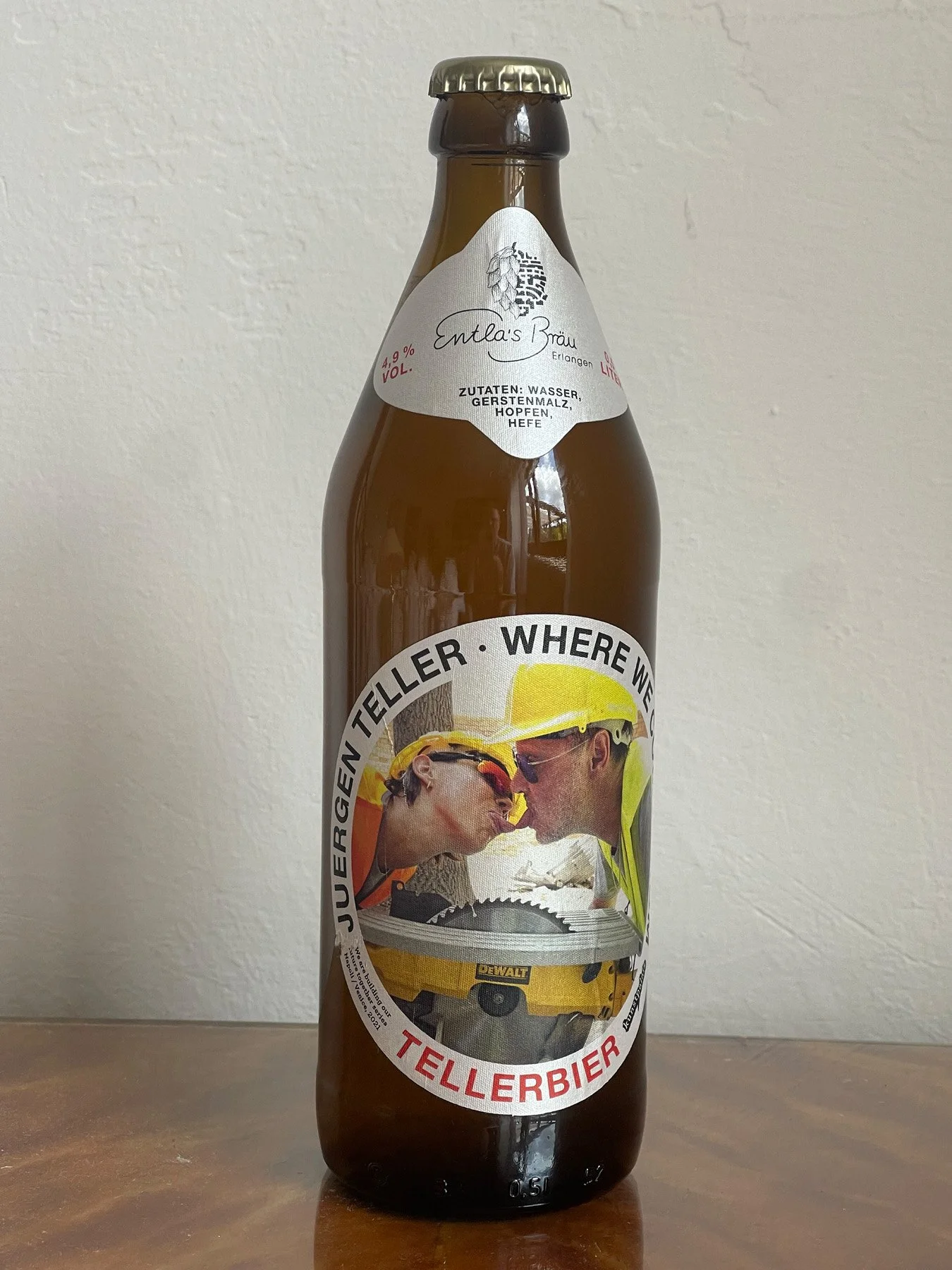
Juergen Teller

Interview by Germano D’Acquisto
There are photographers who chase perfection as if it were a religion — and others who have made imperfection, fracture, and the beauty of the offbeat their signature. Juergen Teller undoubtedly belongs to the latter. His eye never settles for conventional beauty; instead, he dismantles it, mocks it, contaminates it with irony and a touch of disillusionment. Born in Erlangen, Germany, and adopted by London since the 1980s, Teller rewrote the rules of fashion photography at a time when it seemed impossible to break the polished surface of glossy campaigns. He imposed an aesthetic made of natural light, imperfect bodies, disarming gazes, and unpolished settings — the very opposite of traditional glamour, and precisely for that reason, revolutionary.
It’s no coincidence that he’s often cited as one of the key figures behind the “democratization” of fashion imagery — the first to turn glossy pages into a personal diary, raw, direct, and sometimes uncomfortable. Decades later, that gesture seems to have anticipated the stripped-down, almost brutal aesthetic that dominates social media today. Teller, with his trademark refusal to take himself too seriously, tends to deflect such grand claims, but what remains is the power of a visual language that has traversed fashion, portraiture, and autobiography with instinctive immediacy — making his images feel like confessions, though never fully transparent ones.
After major retrospectives at the Grand Palais Éphémère in Paris and the Triennale di Milano, Teller has arrived in Sabbioneta, in a setting that seems tailor-made for his play between intimacy and revelation. 7 ½, curated by Mario Codognato, is perhaps his most personal exhibition to date: a site-specific project retracing his most recent creative phase, marked by renewal and by his personal and professional partnership with his wife, Dovile Drizyte. The title refers both to the years they’ve spent together and to the daily time they share — transforming private life into a kind of public mysticism. In the exhibition, spontaneity becomes an open album: fragments of life offered to the viewer like pages from a generously shared diary.
The installation, conceived with Codognato and executed by Federico Fedel, made full use of the breathtaking perspective of the Galleria degli Antichi and the mirrored ceilings of the Sala degli Specchi, creating a dialogue between the instinctive eye of the photographer and the Renaissance geometry of Sabbioneta. It’s in this encounter — between an aesthetic of imperfection and a space built on proportional perfection — that Teller’s work found its most complete synthesis: that of an artist who keeps reminding us that true beauty always springs from flaws, from imbalance, from life exactly as it is.
We met the renowned photographer on the occasion of the exhibition, which closed on November 23rd, and he spoke candidly about his work, his influences, and the way his personal life shapes his images.

This retrospective in Sabbioneta has been described as your most personal project to date. How did your intimate collaboration with your wife, Dovile Drizyte, shape the narrative and atmosphere of 7 ½?
“It’s simply the time we spend working together, whether it’s a commercial or personal project. For me, this marks a turning point, and it was important to express it for myself and to show it in the gallery.”
The title itself evokes a private mysticism made public through the images. How do you balance intimacy and exposure in your work?
“I show and explore what interests me, what concerns me, what is important and surrounds me. I never show anything truly private: nobody knows how we live, what our house looks like, or our bedroom.”
Your photography has long blurred the lines between fashion, documentary, and biography. How has your visual language evolved in recent years, beyond the fashion world?
“I work more and more in series rather than standalone photographs. My visual language evolves naturally with life, with what I experience and go through.”
Many see you as a pioneer who anticipated today’s social media aesthetics. How do you feel about that influence, and what do you see as photography’s role in contemporary visual culture?
“My aesthetic is the opposite of today’s social media, which is retouched, filtered, and mostly altered. If that’s what you mean. I simply focus on myself and what I want to explore and work on. Photography today seems, unfortunately, pretty vain, banal, and often mediocre.”
Many of your fashion photographs feel more like portraits or small narratives than traditional campaigns. How do you bring storytelling into fashion imagery?
“Through my interest in life, in the person or subject I photograph, and in the clothes, which themselves can tell a story.”

From your early campaigns to recent projects, how has your perception of beauty evolved within the fashion world?
“I wouldn’t know. I don’t even know what 'perception of beauty' really means. What is it, exactly?”
Looking ahead, where do you see your artistic journey going? Are there themes or mediums you haven’t explored yet but feel drawn to experiment with?
“Yes, I’m working on a project where my wife Dovile and I morph into each other. I’ll be showing these images in October at the Onassis Foundation in Athens.”
Do you see fashion photography today leaning closer to art, or has it become even more tied to marketing and digital trends?
“Fashion photography is purely commercial, and that’s how it should be. It should capture the time we are living in, it should have an opinion, and because of that it can be anything you want it to be.”